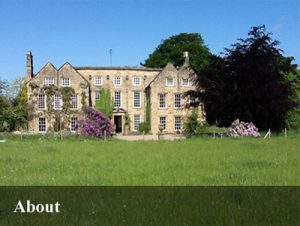
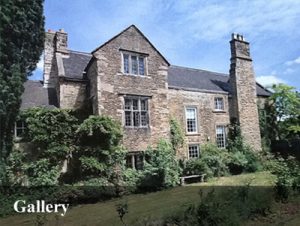
Carnfield Hall is a country house dating from the 15th and 16th Centuries, standing in its ancient deer park and surrounding woods, 1½ miles from junction 28 of the M1 on the Derbyshire/ Nottinghamshire border, a haven of tranquility to this day.

Originally known as Carlingthwaite, old Norse Viking for “an old womans clearing”, it passed to the Babington family in the 15th Century and its first known occupant, Dame Alice Babington married Gregory Page in the 1470s. As a result of serious intimidation and the kidnapping of Mr Page in 1498 by her relative, Hugh Revell, the estate was sold to him in 1502.

Edward Revell remodelled the medieval half timbered house (some of which remains) in the 1570s and his grandsons added panelled rooms and staircases in Jacobean times. Fortuitous marriages with Harpur and Wilmot heiresses in the 17th Century enabled another building phase in the early 1700s by Robert Revell who was unfortunately murdered in 1714 by two of his servants “in his bed”, Oh happy days! He lies today in a resplendent tomb in South Normanton Church, attended by life size weeping Cherubs!

Robert Revell’s grandaughter Frances died aged 20 of the dreaded smallpox in an epidemic that struck Nottingham in 1736, a year after her marriage to the curiously named Strelley Pegge. ( In their love letters she called him “Dear Mr Pegge” and he ” My dearest charmer”! An interesting formality for a future marriage, as well as the fact that Mr Pegge produced a natural son by his mistress, just before his marriage!) Her uncle, the Reverend Francis Revell, inherited Carnfield on her death and lived in the Hall with his wife, mistress and three illegitimate children! In 1770 it passed to his natural son Tristram a Colonel in the army, whose legitimate cousin, Sophia, disputed his right to inherit, but because she had eloped with the family coachman in 1735 had been cut off. On the Colonel’s death in 1797 without children the estate passed to his cousins.

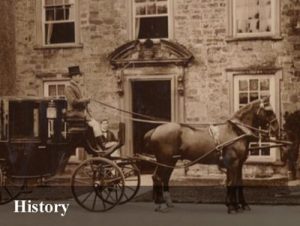
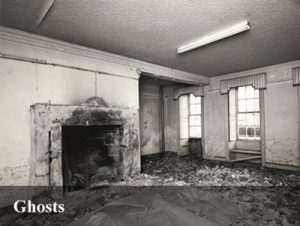
Sir John Eardley-Wilmot got into financial difficulties and to avoid embarrassment to an MP he was made Governor of Tasmania thus removing the problem. So in 1834 he sold the estate to his land agent Joseph Wilson, captain of the Alfreton Cavalry, magistrate and solicitor. Mr Wilson was arrested in 1840 and incarcerated in Derby Gaol for some weeks, dying at Carnfield, just before his trial. In 1912 his grandson Vaughan Radford, a most typical old English country squire died and Carnfield was sold to Alfreton estate agent, Melville Watson. In June 1914 he was murdered by a disgruntled tenant and the ongoing restoration started by him abruptly stopped. His widow lived on at the Hall until her death in 1949 following which it was purchased by local industrialist, Noel Darbyshire, who updated the Hall whilst retaining its original features. Darbyshire abandoned the Hall in 1960 and it remained unoccupied till the previous owner James Cartland bought the property in 1987.

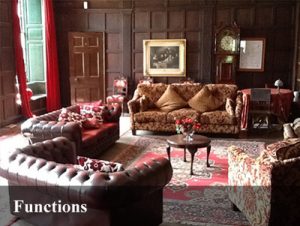
James spent the intervening years restoring this fascinating house. The restoration continued and now includes the ancient park which is to be laid out as it was in the 18th / 19th centuries based on numerous plans and photos found over the years. The work effort and love of the house that James embellished during his ‘tenure’ was nothing short of remarkable and in March of 2011, he passed over the reigns to Graham Oliver.

Graham Oliver adored Carnfield from the moment he set eyes on it in 2010. James Cartland however would only let the house go to someone that shared his long standing passion. It soon became clear to James that Graham was that man.

And so the modern history of Carnfield goes on.